
A documentary usually begins by getting to know the person we want to film: sitting with them, listening to their story, and discovering what the camera might reveal. Ignite the Lantern of My Heart began with a condition that turned that process upside down. We had to make a film about someone who did not know we were making a film about him. It was more than keeping production details secret. The subject himself, poet and academic Dr Mohammed Habibi, knew nothing of the film's existence until he watched it for the first time in front of an audience.
The idea came from his family. They wanted to surprise him with an artistic work at a celebration marking his attainment of a full professorship. His brother, Abdulaziz Habibi, first contacted us, managing the project and coordinating with relatives. The family wanted more than a conventional congratulatory video. They hoped to document something of Mohammed Habibi's human and cultural experience, allowing him to see his life through people who knew and loved him. We found the idea beautiful, but it raised an unusual production and directing question: how could we approach someone's life without meeting, questioning or filming him, or even telling him we were researching his story?
We had to build the film from its edges: other people's memories, archives, photographs and the places his life had passed through. We sought old friends, school and university colleagues, and the poets, writers, critics and academics who knew his work. We also looked for people who had shared his cultural and community activities, including those who knew him during his former presidency of Al-Watan Club. We wanted details that would help us discover the person behind the titles, rather than a sequence of tributes. What had he been like in his early years? What had stayed constant as his life changed? How did those close to him see his relationship with poetry, place and family?
As the research developed, we discovered that he was more than a poet who wrote and published poems. Mohammed Habibi had experimented early with multimedia poetry, bringing verse together with photography, music and other artistic media. We found a website documenting some of those experiments from around twenty years earlier. Certain works could not be reduced to printed pages: they were designed to be read, seen and heard at once. That discovery mattered to me. It introduced us to an artistic and literary world whose details we had not known well, and prompted another question. If our subject had spent years searching for a language that joined poetry, image and sound, could our film draw on that language as well as describe it?
We began to see the film differently. Rather than arranging successive testimonies to recount a life from childhood to the present, we searched for a visual and aural rhythm close to his world. Poems, photographs, places and voices became the material through which we tried to build a character who never appeared before our camera. We understood that his absence from filming was a defining fact of the project. Each person saw him from a different angle. Each old photograph revealed something of a time we could not bring back. Each place carried a trace of his life, even when he was not there.
Accessing the archive was a story of its own. We needed photographs and materials from his office and personal belongings, but could not simply ask him. His children helped us find older images and documents in his office while he was away, without revealing the reason for their sudden interest. Small as that might sound, it captured the nature of the entire project: making a film about someone while trying to leave no trace of its existence. Even a visit, a phone call or a crew member entering a familiar place needed coordination to protect the surprise.
Filming his mother was one of the most sensitive days. We went to her house for an interview and to film places connected with family memory, including his old library. But Mohammed Habibi visited her almost daily around sunset prayers, and might arrive unexpectedly. His children followed his movements, keeping him occupied and coordinating with him without raising suspicion as we filmed. We were working in a house he knew well, listening to his mother recall his childhood and life, while watching the clock. It was a strange mixture of intimacy and anxiety. The scene needed calm and attention, but we knew our subject could knock on the door at any moment.
I also remember interviewing his only daughter, who was visiting Saudi Arabia during a break from her studies in the United States. We filmed her before she returned to university, which meant she could not later attend the celebration. Yet the film allowed her father to see her and hear her words that evening, despite the distance between them. At moments like that, a film reaches beyond recording information. It brings together people, times and places that the occasion itself may be unable to gather in one room.
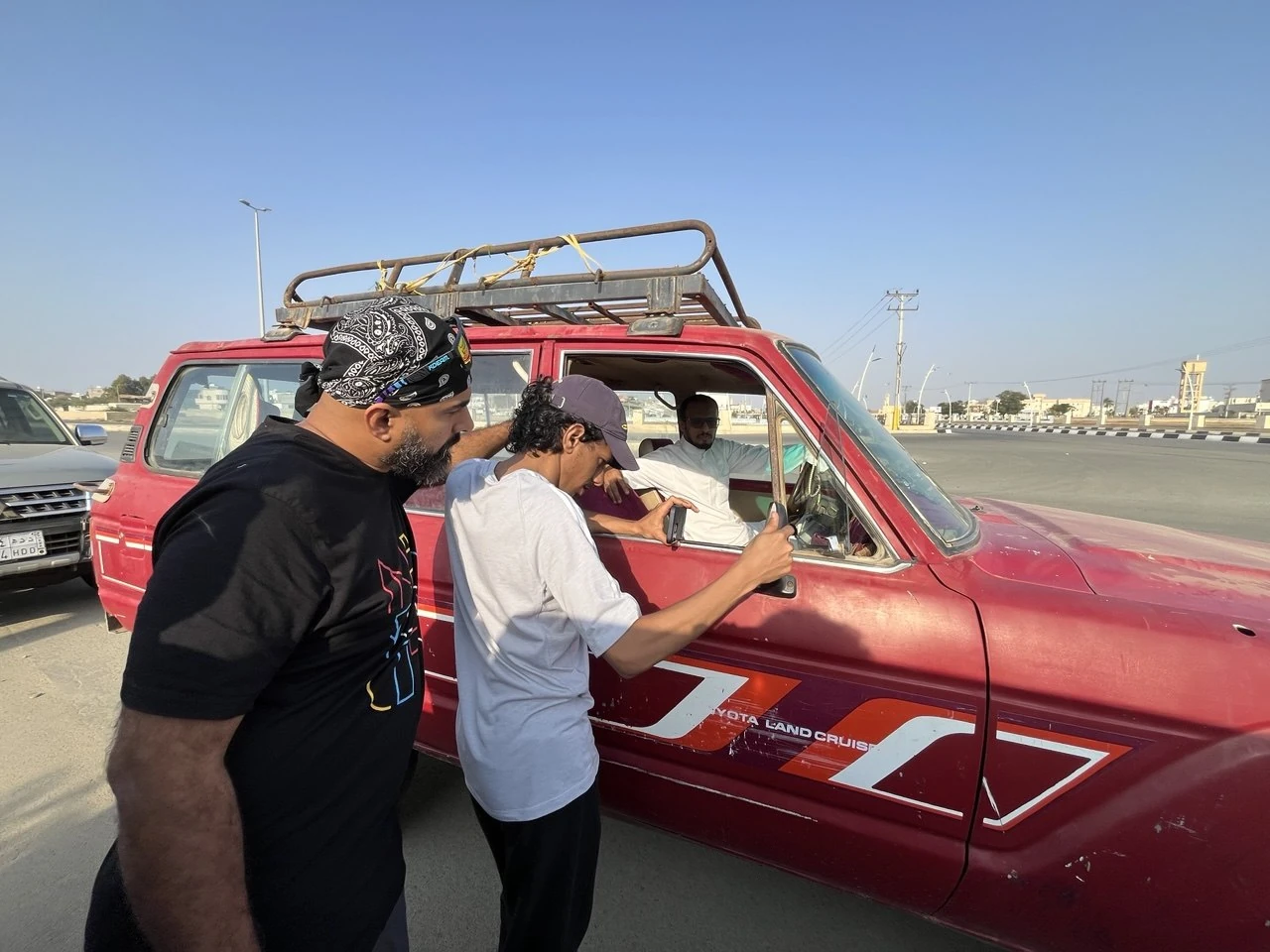
Another part of the story concerned his late father, who died during the coronavirus pandemic. We learned that an old red car belonging to his father held a special place in the family's memories, and particular meaning for Mohammed Habibi. We decided to bring it back into the film as a trace of the father's life. His brother Abdulaziz drove it for the camera, through streets, narrow lanes, farms and the places their father had travelled. We wanted to give memory a visible form without directly reenacting every event. The father was absent from the image, but the car carried something of his presence.
Filming the car also had an emotional weight. It was a real object from the family's life, connected with someone who had died and left a deep impression on his children. When Mohammed Habibi later watched those scenes, they were among the moments that moved him most. I believe their strength came from their simplicity. We did not need a long explanation of what the car meant. Its presence in the places his father had known was enough to call up an entire memory.
Even the title came from Mohammed Habibi's poetry. One of his collections was called Extinguish the Lantern of My Heart, which inspired Ignite the Lantern of My Heart. We liked the reversal. The film we were secretly making for him felt like an attempt to illuminate part of his life through the memories he had left with others. As the work progressed, the title became more closely connected with the film's nature, especially as many of the testimonies revealed human details that might never appear in a professional or academic biography.
We kept trying to protect the secret until the end. Many relatives, friends and colleagues were involved, and keeping any hint from reaching him was difficult in a community where relationships overlap and people know one another. Everyone was determined to preserve the surprise. We knew the first screening would be unlike any we had experienced. The audience would be watching a film about someone sitting among them, while that person had no idea what awaited him.
Then came the evening of the celebration. We attended with the film crew, including the director, production manager Ibrahim Zouli, the director of photography and sound engineer Majed Alhazmi. For me, it was more than showing a completed work. It was the first time a documentary I had produced would screen for an audience in my own town of Damad, Jazan, giving the evening an additional personal meaning. I watched the audience and waited for Mohammed Habibi to realise that the film was about his own life: the people he knew, the places he had lived, and details he might never have expected to see on a screen.
His reactions were part of the experience we could never have planned. He saw his mother, friends and daughter, and rediscovered his father's presence through images of the red car. He was moved and happy, and the audience received the film warmly. At that moment I felt we had achieved something we had feared might be impossible: making a film about a person without his direct participation, then presenting it in a way that made him feel present within it.
Ignite the Lantern of My Heart taught me that a documentary does not always need its subject to sit before the camera for us to approach him. Sometimes we come to know a person through the space they occupy in other people's lives, the things those people keep and the places where they remember him. Mohammed Habibi was absent from every stage of the filmmaking, yet present in every conversation, photograph and location we visited. When he finally sat before the screen, he saw himself in a way he had never had the chance to see before: through the eyes of his mother, brother, daughter, friends, and everyone who helped illuminate a part of his story.