
We did not have a large budget, a huge production crew, or the time you would normally wish for on a commercial of this scale. We had a project to launch Masnaf restaurant in Riyadh, an initial advertising concept, and a shared desire to make something different. When we finished and showed the film to colleagues in advertising, some estimated that it had cost five or six times our actual budget. What mattered to me was less the comparison than the thought behind it: the images we had made had reached beyond the resources available to us.
The project began with an idea from the creative agency. Someone would enter a restaurant in Riyadh, suddenly find himself in Jazan, experience a visual and cultural journey, then return to the restaurant. It was a promising concept, but we felt from the start that it needed a different treatment. In our early conversations, director Musab Muharraq, Mohammed Asiri and I began asking why the commercial should simply be a fantasy journey that ended back at the restaurant. Why not make Jazan itself the story, with its cultures, places, faces and colours? We wanted the spirit of the region to lead the film, rather than serve as a beautiful backdrop.
Gradually, entering the restaurant in Riyadh became a doorway into another world. The commercial opens amid the bustle of the city, then its central character crosses the restaurant threshold into a journey through mountains, valleys and the sea. We agreed to give viewers time to enter that experience before revealing the restaurant at the end, rather than rushing to present the product or commercial message. We wanted people to feel that Masnaf had brought something of Jazan with it to Riyadh. It was a creative risk. Advertising often tries to establish a brand quickly; we were asking the client to trust the story until its final moment.
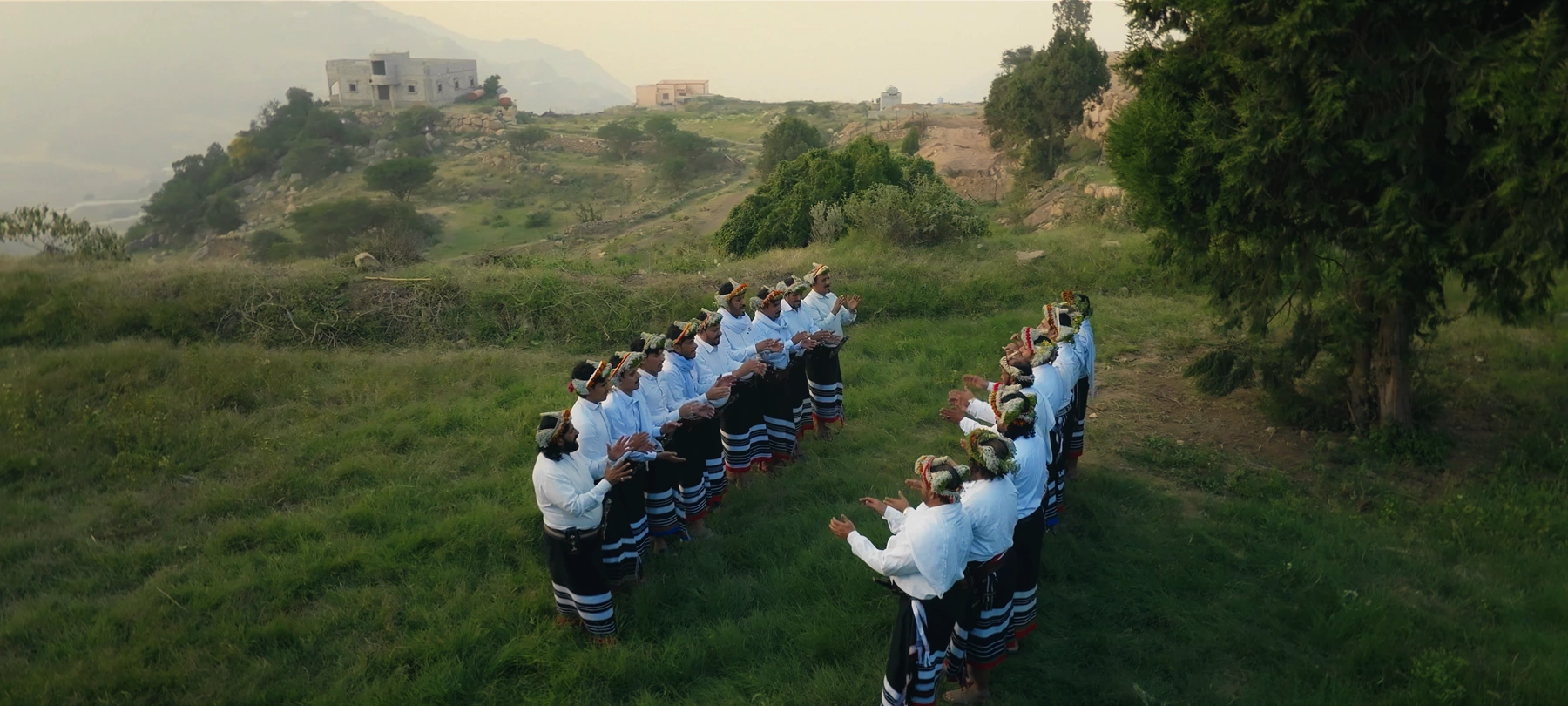
Jazan cannot be contained in a single image. Anyone who knows the region understands the differences between its mountains, plains, coast and islands, and between the clothes, songs and customs of each environment. We built the journey around that cultural diversity, rather than a succession of landscapes. In the mountains, we went to Jabal Al-Hashr and drew on elements of Khawlan culture and dress, including Al-Harisi attire, alongside a young girl from the mountain community. In Tihama, we chose Wadi Al-Fatihah, with its palms, greenery and open views, to film traditional performance in its natural setting. For the coastal scenes, we turned to the Farasani house, traditional adornments, jasmine, kadi and gold, and drew inspiration from the Farasani bride and customs such as Al-Mayl and Laylat Al-Haml. We were not trying to make a comprehensive guide to Jazan's cultures. We wanted a short journey whose details would feel familiar and true to people from the region.
Those details required care beyond location selection. Clothing, jewellery, performers' movements, the quality of the light and even smoke passing in front of the camera all helped build the commercial's world. With costume coordinator Noura Abri, we worked towards a visual presence that respected the particular environments we were filming. We wanted cinematic images that retained a sense of place. I would sometimes watch a small detail change an entire scene: an ornament, the colour of a garment, or the way light entered a room. At the same time, we had to take care not to turn heritage into attractive decoration detached from its context.
We also made a decision that mattered personally to me: most of the execution crew would come from Jazan. Some had never worked on a commercial with demands of this kind, but I knew their abilities. Experience cannot grow if we wait for everyone to possess it before giving them an opportunity. We brought in creative leads from Riyadh and worked with a local crew across camera, production, equipment and field services. It was more than an emotional choice. Their knowledge of the region, relationships with its people and ability to navigate locations and circumstances were a real part of the film's success. Most importantly, the project left behind professional relationships that continued after filming ended.
Working in real locations with large groups of participants does not always follow the shooting schedule. One night, before an important shoot, an unexpected problem reached us. It was nearly ten in the evening when the traditional performance group withdrew, following a late request to change costumes. We had prepared the shooting day and organised all its elements; finding a replacement within hours would be difficult. Musab, Mohammed Asiri, Ahmed Sharif Zouli and I met and decided to cancel the next day's shoot. It was expensive, especially on a limited budget, but seemed better than filming a scene we did not believe in simply to keep to the schedule.
We used the lost day to search for a better location. Returning to explore the area, we found a space in the valley that offered a richer composition than we had planned. It did not fully compensate for the loss, but reminded me that a decision which feels like a retreat can open a door we had not seen. In filmmaking, the problem is not always that something unplanned has happened. It is whether we can respond without losing the film we are trying to make.
Then came the day of the scene I remember most vividly. Musab wanted many elements in one frame: the traditional performance group in the foreground; behind them, camels and their young herder; then palms, green fields, mountains and sky. It was beautiful on paper. In practice, nature, people, animals and time all had to cooperate at once. The group arrived late, the sun was falling quickly, and we had very little time left to get the shot. The camels were unsettled by the smoke, music and movement around them, moving away whenever we tried to bring them into position.
I found myself beside Musab, trying to guide the camels towards the background he wanted and calm them while the crew prepared to shoot. There was no time for long explanations or dozens of attempts. When the camels finally came close to their positions, we hurried out of frame before the take began. To the viewer, it may look natural, as if everything simply happened where it should. Whenever I see it, I remember the running, the confusion, the disappearing sun, and our repeated attempts to persuade the camels to stand where the director had chosen.
The challenges were creative as well as practical. There were discussions about some musical choices and about how much space we had given the cultural journey before revealing the restaurant. These are familiar conversations in advertising: the agency and client consider the commercial message, while the director and crew search for its artistic language. A degree of trust helped us defend our choices while remembering that the commercial had ultimately been commissioned to serve a specific business purpose.
The client's response when the film was finished was one of the moments that made us happy. I received an enthusiastic voice message, full of words such as “incredible” and “beautiful”. The commercial then began to spread, reaching millions of views across different platforms. More than the numbers, I remember the response from people in Jazan, who recognised their places and details of their lives and culture. Many comments spoke about the mountain, clothing, dances and scenes that brought back memories, as well as the restaurant.
The film opened doors we had not expected. Afterwards, PepsiCo invited us to compete for an advertising project alongside much larger agencies and companies, some working internationally. At the time our core team numbered just three or four people. We reached the third round without winning the project, but being there was an important experience in itself. It was not a commercial victory. It showed us that the size of a company does not necessarily determine the scale of the opportunities that can reach it.
I sometimes think of Masnaf as one of the projects that taught me a budget is only part of the production equation. Some things are difficult to buy: knowledge of a place, trust between crew members, a willingness to step back from an unsuitable decision, and the ability to see a new opportunity inside an unexpected problem. That does not make financial resources unimportant. A larger budget would have made some things easier. But limited resources pushed us to rely more on thought, cooperation and flexibility.
Whenever I return to the commercial, I find myself waiting for the valley scene. I watch the performers, camels, palms and mountains, remembering that behind those few seconds were a cancelled shooting day, a location discovered late, a sun about to set, and a director and producer running out of frame. Perhaps that is why I love talking about filmmaking as much as I love films themselves. There is always another story the viewer does not see, one that remains in the memories of the people who made the image.